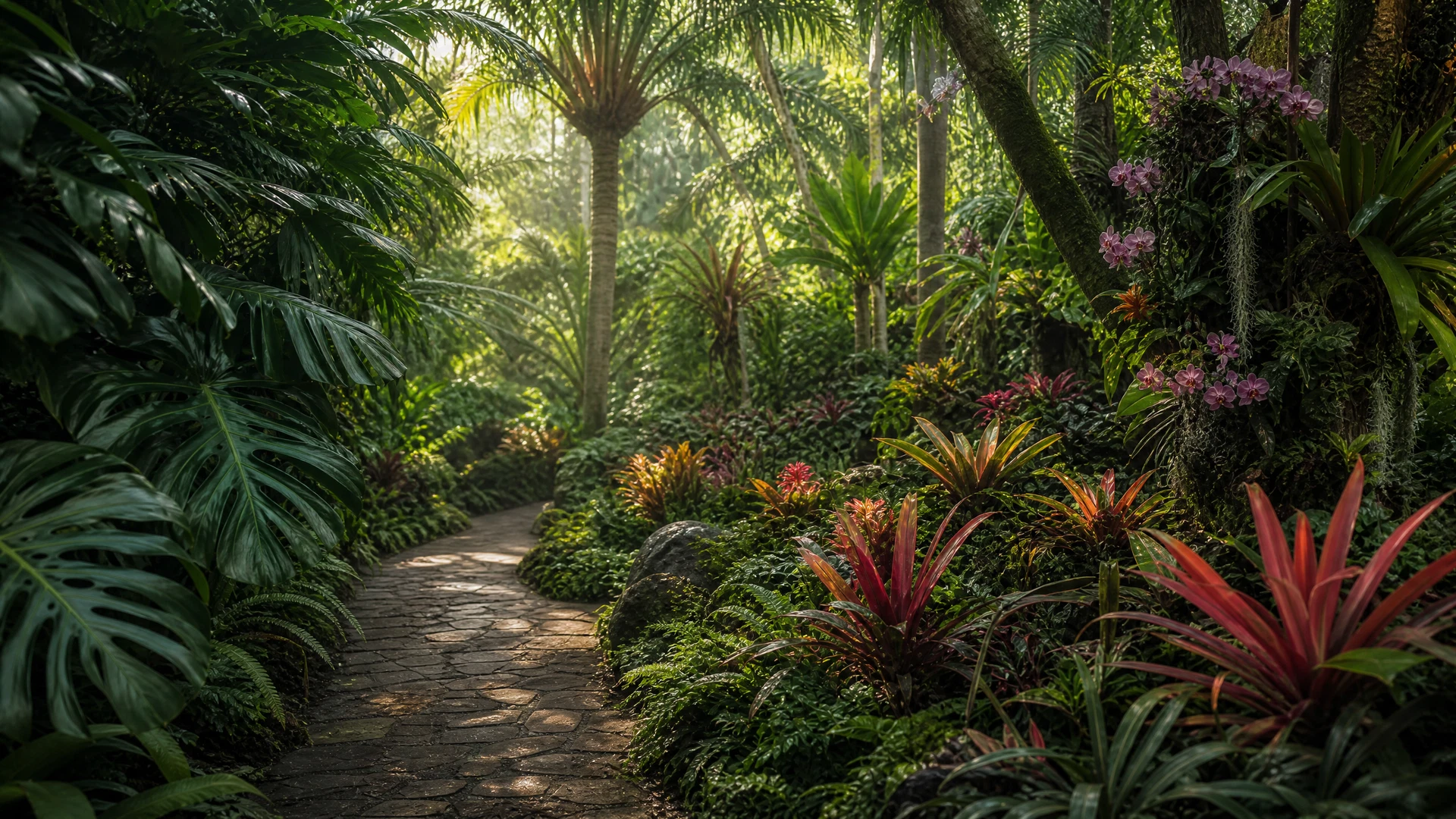
Florida Botanical Gardens: Where the Tropics Begin
The only continental US state where you can grow vanilla orchids outdoors — and its gardens make the most of every degree.
BotanicalGardens.blog Editorial Team
Editorial research & source verification
Tropical & Subtropical seasonal guide
Florida Month-by-Month Bloom Calendar
Warm climates provide meaningful color year-round. The most comfortable visit windows are generally the cooler, drier months, while summer intensifies tropical growth.
Garden color at a glance
Typical regional timingJan
Comfortable-season color: orchids, palms, flowering trees, and tropical shrubs.
Feb
Comfortable-season color: orchids, palms, flowering trees, and tropical shrubs.
Mar
Comfortable-season color: orchids, palms, flowering trees, and tropical shrubs.
Apr
Comfortable-season color: orchids, palms, flowering trees, and tropical shrubs.
May
Lush wet-season growth: gingers, hibiscus, water plants, and heat-loving collections.
Jun
Lush wet-season growth: gingers, hibiscus, water plants, and heat-loving collections.
Jul
Lush wet-season growth: gingers, hibiscus, water plants, and heat-loving collections.
Aug
Lush wet-season growth: gingers, hibiscus, water plants, and heat-loving collections.
Sep
Lush wet-season growth: gingers, hibiscus, water plants, and heat-loving collections.
Oct
Year-round color continues with orchids, bromeliads, palms, and flowering trees.
Nov
Year-round color continues with orchids, bromeliads, palms, and flowering trees.
Dec
Year-round color continues with orchids, bromeliads, palms, and flowering trees.
Bloom schedules shift with elevation, microclimate, rainfall, and the previous winter. Use this as a regional planning guide, then check each garden's official bloom tracker or event calendar before making a special trip.
In This Guide
Florida's Garden Legacy
Florida is the botanical anomaly of the continental United States. It is the only state where you can grow vanilla orchids, royal palms, and bald cypress in the same garden — outdoors, year-round, without a greenhouse. Fairchild Tropical Botanic Garden in Coral Gables holds the world's most comprehensive collection of palms and cycads. Marie Selby Botanical Gardens in Sarasota has published more scientific papers on epiphytes than any institution outside Kew. Naples Botanical Garden focuses exclusively on plants from between the 26th parallels — a geographic range that covers most of the world's biodiversity hotspots. Florida's gardens are not just beautiful. They are doing serious science.
The story of Florida horticulture begins with David Fairchild, the USDA plant explorer who spent decades traveling the world collecting economically useful plants — mangoes, dates, soybeans, bamboo — and introducing them to American agriculture. He eventually settled in Miami, and in 1938 his friend Robert Montgomery named a new garden after him. That garden, Fairchild Tropical Botanic Garden, now holds 83 acres of the most biodiverse tropical plant collection in North America. Marie Selby, a Sarasota socialite and passionate gardener, bequeathed her bayfront estate to the public in 1971 with instructions to make it a botanical garden. It opened in 1975 and became the world authority on epiphytes within a decade.
Florida's native flora is under significant pressure — the state loses roughly 25,000 acres of natural land per year to development, and over 400 native plant species are listed as threatened or endangered. Its botanical gardens are among the most active conservation institutions in the country in response. Fairchild's Center for Tropical Plant Conservation maintains seed banks for over 200 threatened South Florida species. The Key West Tropical Forest & Botanical Garden is the only frost-free botanical garden in the continental US and serves as a refuge for Caribbean plant species that have no other protected habitat on American soil.
Climate & Plant Diversity
Florida's climate is a gradient, not a single condition. The Panhandle is humid subtropical — cold enough for azaleas and camellias, warm enough for live oaks draped in Spanish moss. Central Florida is subtropical with a dry season from November to April and a wet season that dumps 50 inches of rain between June and September. South Florida, below Lake Okeechobee, is genuinely tropical: frost-free, humid year-round, and capable of growing mangoes, avocados, and lychees as street trees. The Florida Keys are the only part of the continental US with a true tropical maritime climate, which is why the Key West Tropical Forest & Botanical Garden can grow plants that would otherwise require a heated greenhouse anywhere north of Miami.
USDA hardiness zones in Florida span from 8b in the Panhandle to 11b in the Keys — a range of three full zones that encompasses everything from cold-hardy camellias to coconut palms. The practical implication for garden visitors: a garden in Pensacola and a garden in Miami are growing in essentially different countries, botanically speaking. Miami-Dade County alone has more native plant species than all of New England. Florida's botanical gardens have built their collections to reflect this diversity, which is why a single day at Fairchild can feel like a tour of the world's tropical regions.
| Region | USDA Zone | Climate Type | Notable Plants |
|---|---|---|---|
| Northern Florida | 8b - 9a | Humid Subtropical | Azaleas, Camellias, Southern Magnolias, Longleaf Pine |
| Central Florida | 9b - 10a | Humid Subtropical | Citrus, Hibiscus, Bougainvillea, Live Oak, Sabal Palm |
| South Florida | 10b - 11a | Tropical | Orchids, Bromeliads, Royal Palm, Mango, Frangipani |
| Florida Keys | 11a - 11b | Tropical | Mangroves, Sea Grape, Buttonwood, Gumbo Limbo |
Featured Botanical Gardens in Florida
Fairchild Tropical Botanic Garden is the most important tropical plant collection in the continental United States. Founded in 1938 in Coral Gables, its 83 acres hold the world's most comprehensive palm collection (over 2,500 specimens), the largest cycad collection outside South Africa, and a two-acre rainforest with Amazonian flora. The Wings of the Tropics butterfly conservatory releases 2,000 live butterflies daily. Fairchild's conservation program has collected seeds from over 200 threatened South Florida native species — a living insurance policy against the development that has consumed most of the state's natural habitat.
Historical Note: Founded in 1938 by Robert H. Montgomery and named after his friend David Fairchild — the USDA plant explorer who introduced over 200,000 plant species and varieties to the United States, including mangoes, dates, and soybeans. Landscape architect William Lyman Phillips designed the grounds with an emphasis on open vistas and discovery. The garden has been a National Historic Landmark since 2003. [Wikipedia]
Marie Selby Botanical Gardens is the world's foremost authority on epiphytes — plants that grow on other plants without soil, including orchids, bromeliads, and ferns. On 15 bayfront acres in Sarasota, it holds over 5,500 orchid specimens and 3,500 bromeliads, and its scientific staff has described dozens of species new to science. The Christy Payne House, a 1934 Mediterranean Revival mansion on the property, is listed on the National Register of Historic Places and houses the Museum of Botany and the Arts. The Ann Goldstein Children's Rainforest Garden is one of the best-designed children's garden spaces in the Southeast.
Historical Note: Marie Selby, a Sarasota socialite and passionate gardener, bequeathed her bayfront estate to the public in 1971 with instructions to establish a botanical garden. It opened in 1975 and published its first peer-reviewed epiphyte research within three years. The garden's scientific journal, Selbyana, has been the primary publication for epiphyte research since 1975. [Wikipedia]
Naples Botanical Garden is built around a single compelling idea: focus on the plants that grow between the 26th parallels north and south — the tropical and subtropical band that contains most of the world's plant biodiversity. On 170 acres in Southwest Florida, it has assembled distinct garden zones representing Florida, Brazil, the Caribbean, Asia, and the water-scarce regions of the world. The Brazilian Garden, designed by Raymond Jungles, is widely considered one of the finest examples of tropical landscape design in the United States. The children's garden is exceptional, with a treehouse, water play areas, and a butterfly house.
Historical Note: Founded in 1993 by a group of Naples residents who wanted a world-class botanical garden in Southwest Florida, the garden opened its first phase to the public in 2009 after a 16-year planning and development process. The Brazilian Garden, completed in 2012 and designed by landscape architect Raymond Jungles, won the American Society of Landscape Architects' Award of Excellence. [Wikipedia]
Mounts Botanical Garden
Located in West Palm Beach, Mounts Botanical Garden is Palm Beach County's oldest and largest botanical garden, spanning 20 acres. It features 25 display gardens showcasing more than 7,000 species of tropical and subtropical plants from around the world. The garden serves as a living laboratory, demonstrating best practices for horticulture in South Florida and offering a tranquil escape for visitors. Its diverse collections include a tropical fruit arboretum, a garden of native plants, and unique themed areas like the Windows on the Floating World – Blume Tropical Wetland Garden and the serene Garden of Tranquility [4].
Historical Note: While botanical plantings began in the 1950s, the vision for a Horticultural Learning Center took shape in 1975, leading to the garden's official establishment in 1983 and renaming in 1986. The garden has undergone significant restoration efforts, particularly after sustaining damage from hurricanes in 2004 and 2005, which led to the revitalization of its tree canopy and overall landscape [4].
Quick Comparison Table
| Name | Location | Founded | Acreage | Admission | Best For |
|---|---|---|---|---|---|
| Fairchild Tropical Botanic Garden | Coral Gables | 1938 | 83 acres | Admission Fee Applies | Tropical Plant Enthusiasts |
| Marie Selby Botanical Gardens | Sarasota | 1975 | 15 acres | Admission Fee Applies | Orchid & Bromeliad Lovers |
| Naples Botanical Garden | Naples | 1993 | 170 acres | Admission Fee Applies | Global Plant Diversity |
| Mounts Botanical Garden | West Palm Beach | 1983 | 20 acres | Admission Fee Applies | Tropical & Subtropical Diversity |
Visitor Planning Tips
- Hydrate and Protect: Florida's sun can be intense, especially during summer months. Always carry water, wear sunscreen, a hat, and sunglasses. Many gardens offer shaded pathways and rest areas, but preparation is key for an enjoyable visit.
- Visit During Cooler Months or Early Hours: To avoid the peak heat and humidity, consider visiting between November and April. If visiting during summer, plan your trip for early mornings right after opening or late afternoons to experience more comfortable temperatures.
- Check for Special Events: Florida's botanical gardens frequently host festivals, workshops, and seasonal exhibits. Check their official websites in advance to align your visit with unique events like orchid shows, mango festivals, or native plant sales, which can greatly enhance your experience.
- Embrace the Wildlife: Many gardens are also sanctuaries for local wildlife, including various bird species, butterflies, and even reptiles. Keep an eye out for these natural inhabitants, but remember to observe from a respectful distance and avoid disturbing them.
Frequently Asked Questions
References
BotanicalGardens.blog Editorial Team
Editorial research & source verification
About the editorial team
BotanicalGardens.blog publishes as an editorial team. We do not claim individual credentials or first-hand visits unless a page identifies and substantiates them. Our process prioritizes official garden records, public institutions, and clearly named sources.
Editorial verification
This guide is researched from official garden pages, public institutions, and other named sources where available. Visitor details can change; confirm hours, ticketing, and accessibility directly with the garden before a special trip.
Read our editorial standards or report a correction at corrections@botanicalgardens.blog.