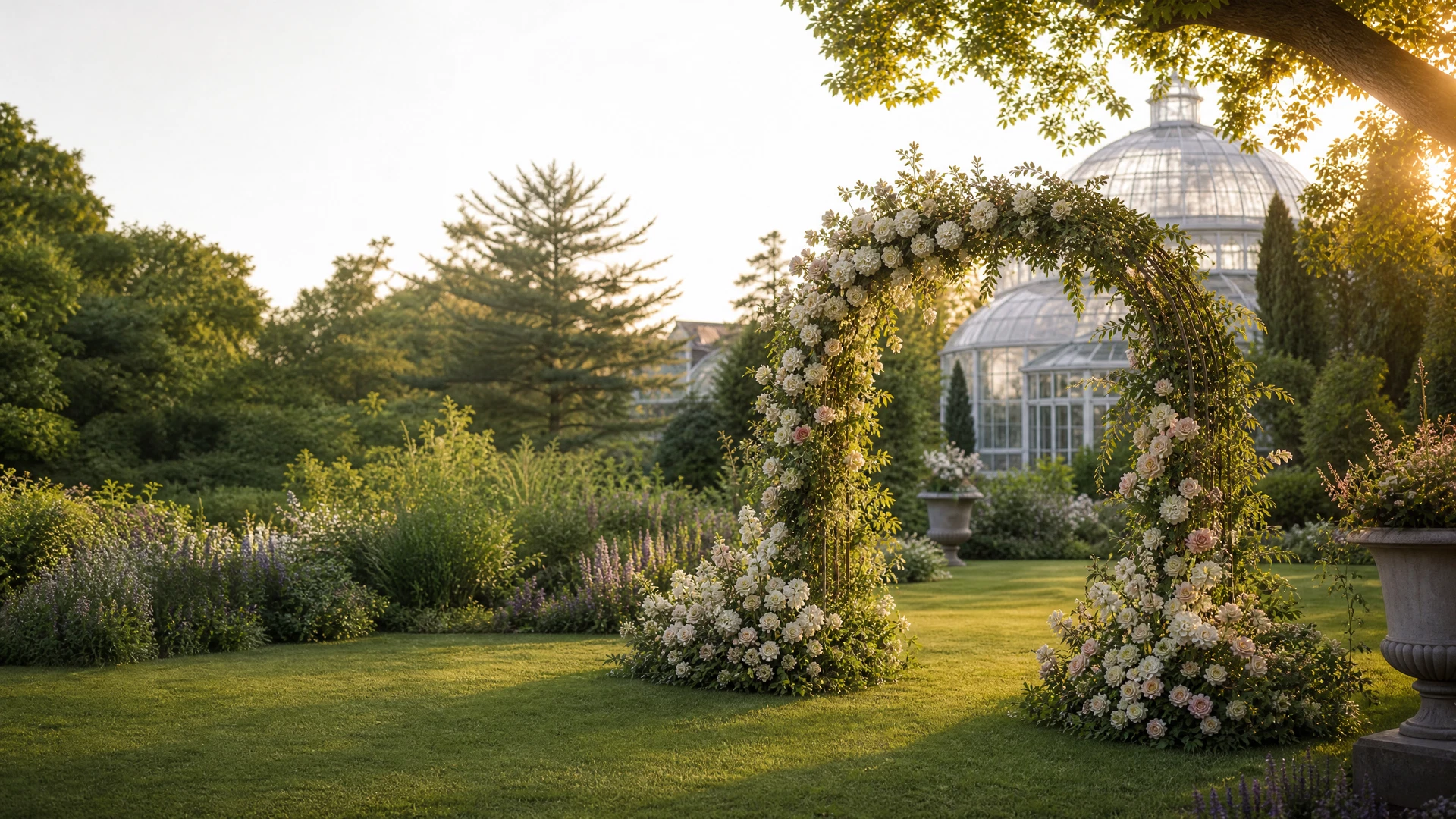
Wedding Planning Guide
How to Plan a Botanical Garden Wedding: The Complete Guide
From booking 18 months out to navigating approved vendor lists, here's everything you need to know to pull off the most beautiful day of your life — without losing your mind in the process.
BotanicalGardens.blog Editorial Team
Editorial research & source verification
In This Guide
- Why a Botanical Garden Wedding?
- Choosing the Right Garden Venue
- Booking Timeline & Availability
- Vendor Selection: What's Different
- Navigating Approved Vendor Lists
- Florals: Working With the Garden
- Day-Of Logistics & Garden Rules
- Best Seasons by Region
- Budget Realities
- Top Venues by Wedding Style
- Frequently Asked Questions
There is a particular kind of magic that happens when you get married in a botanical garden. The light is different — filtered through a canopy of mature oaks or bouncing off a glass conservatory at golden hour. The smell is different — jasmine and rose and warm earth instead of carpet cleaner and banquet hall. And the photographs are, frankly, unfair to every couple who got married in a hotel ballroom.
But botanical garden weddings come with a set of considerations that your average wedding venue does not. Gardens are living institutions with conservation missions, public visiting hours, approved vendor lists, and rules about what you can and cannot stake into the ground. The couple who books one of these venues without doing their homework will have a stressful experience. The couple who understands how they work will have the wedding of their lives.
This guide covers venue-selection questions, booking logistics, vendor rules, budget considerations, and planning links for gardens that publish private-event information. Event packages, restrictions, and availability differ by garden, so use the listed official venue pages to confirm decisions before signing a contract.
Why a Botanical Garden Wedding?
The obvious answer is beauty, and yes, the beauty is real. But the more interesting answer is context. A botanical garden is a place that exists to celebrate the natural world in its most curated, considered form. Getting married in one is not just using a pretty backdrop — it's aligning your ceremony with a place that has been deliberately, lovingly designed to make people feel something. That's a meaningful distinction.
Practically speaking, botanical gardens also solve several problems that plague other outdoor venues. The grounds are professionally maintained year-round, so you're not gambling on whether the grass will be green or the hedges trimmed. The infrastructure — pathways, lighting, restrooms, parking — is already built for large numbers of visitors. And the setting provides its own décor: you don't need to spend $8,000 on floral installations when you're getting married in front of a 200-year-old wisteria vine.
The trade-offs are real too. You will likely be working within a more structured framework than a private estate or blank-slate venue. Gardens have rules, approved vendor lists, and sometimes other events happening on the same day in different sections of the property. Understanding these constraints upfront — and choosing a garden whose structure suits your style — is the foundation of a successful botanical garden wedding.
The Key Advantage
A mature botanical garden can offer established landscape character that changes the event-design brief. A rose garden, fountain setting, or Japanese landscape may reduce the amount of additional décor a couple wants, but venue inclusions, restrictions, and floral needs differ by site and season. Use each garden's official private-events materials to compare what is actually included.
Choosing the Right Garden Venue
Not all botanical gardens host weddings, and among those that do, the experience varies enormously. Some gardens offer full-service event packages with in-house catering, dedicated event coordinators, and exclusive access to the entire property. Others rent a single pavilion or terrace and leave you to source everything else. Before you fall in love with a garden's Instagram presence, you need to understand what you're actually buying.
Questions to Ask Every Venue
The following questions will reveal more about a venue's suitability than any site visit:
- Is the garden open to the public on the day of my wedding? Many gardens remain open during private events. This is not necessarily a dealbreaker, but it changes the character of the day significantly.
- What is the maximum guest capacity for each event space? Gardens often have multiple spaces with very different capacities. The ceremony garden might hold 150; the reception pavilion might hold 80.
- What are the noise restrictions and end times? Many botanical gardens are in residential areas or have sound-sensitive conservation areas. Live bands, amplified music, and late-night receptions may be restricted or prohibited.
- What is the rain plan? This is non-negotiable. Outdoor garden weddings need a concrete contingency — not "we'll figure it out." Ask specifically: is there an indoor space, what is the cost to add it, and how late can you make the call?
- Are there any seasonal closures or major events that could affect our date? Many gardens have annual festivals, plant sales, or conservation events that take priority over private bookings.
- What is the policy on décor, staking, and floral installations? Some gardens prohibit anything staked into the ground, restrict open flames, or require that all décor be freestanding. Know this before you brief your florist.
Matching Garden Type to Wedding Style
| Wedding Style | Best Garden Type | Example Venues |
|---|---|---|
| Grand & formal | Estate gardens with conservatories | Longwood Gardens (PA), Filoli (CA), Cheekwood (TN) |
| Intimate & romantic | Japanese or contemplative gardens | Portland Japanese Garden (OR), Japanese Friendship Garden (CA) |
| Tropical & exotic | Tropical or subtropical gardens | Fairchild (FL), The Kampong (FL), Waimea Valley (HI) |
| Desert & dramatic | Arid/desert botanical gardens | Desert Botanical Garden (AZ), Tucson Botanical (AZ) |
| Urban & chic | City botanical gardens | Brooklyn Botanic (NY), Atlanta Botanical (GA), NYBG (NY) |
| Historic & literary | Estate gardens with mansion | Filoli (CA), Paine Art Center (WI), Dumbarton Oaks (DC) |
Booking Timeline & Availability
Here is the single most important piece of advice in this entire guide: botanical garden venues book 12 to 24 months in advance for peak dates. This is not a polite suggestion. The New York Botanical Garden, Longwood Gardens, and Cheekwood Estate are routinely booked 18 months out for April, May, September, and October Saturdays. If you have a specific date in mind and a specific garden in mind, you need to move immediately.
The good news is that flexibility on date and day of week opens up significantly more options. A Friday evening or Sunday afternoon at a premier garden is often available on shorter notice and at a lower rental rate than a Saturday. Shoulder season dates — late February through March, and November — are dramatically easier to book and often more beautiful than you'd expect, particularly in the South and on the West Coast.
Recommended Booking Timeline
Begin venue research and site visits. Secure your first-choice garden's hold date if offered.
Sign venue contract and pay deposit. Begin researching approved vendor lists.
Book photographer, videographer, and florist — these vendors book out fastest at garden venues.
Book caterer (if not in-house), band or DJ, officiant, and hair/makeup.
Confirm all vendor logistics with the garden's event coordinator. Begin décor planning.
Finalize guest count, catering menu, ceremony details, and day-of timeline.
Final walkthrough with all vendors. Confirm rain plan trigger time and process.
Vendor Selection: What's Different at a Garden Wedding
Planning a botanical garden wedding requires a different vendor mindset than planning a hotel or private estate wedding. The vendors who thrive in garden settings are those who understand how to work with the existing environment rather than against it — photographers who know how to use dappled light, florists who can source from the same plant families as the garden's collections, caterers who can execute elegant service on uneven terrain.
Photographer
Your photographer is the most important vendor you will book for a garden wedding, and the one where experience with the specific venue matters most. A photographer who has shot at the Brooklyn Botanic Garden knows where the light falls at 5pm in October, which paths are open to the public and which are private, and which corners of the Japanese Hill-and-Pond Garden are genuinely magical versus merely pretty. Ask every photographer you interview: Have you shot at this garden before? Can I see those images?
If your first-choice photographer hasn't shot at your venue, that's not disqualifying — but ask them to do a site visit before the wedding day. The difference between a photographer who knows a venue and one who's navigating it for the first time shows in the final gallery.
Florist
The best garden wedding florists approach the job as a conversation with the existing landscape rather than a competition with it. At a garden like Longwood or the Huntington, the grounds themselves are the primary floral statement — your florist's job is to complement and frame, not overwhelm. Florists who specialize in garden weddings tend to favor loose, naturalistic arrangements with seasonal, locally sourced flowers that echo the garden's own collections.
One practical note: many botanical gardens have strict rules about what can be staked into the ground, attached to existing plants, or used near conservation areas. Brief your florist on these restrictions before they develop a proposal. A florist who designs a ceremony arch that requires staking into the garden's historic rose bed will create a problem you don't want to solve two weeks before your wedding.
Caterer
Garden venues present specific logistical challenges for caterers: often no commercial kitchen on-site, long distances between prep areas and service areas, outdoor service in variable weather, and strict rules about what can be brought onto the grounds. Experienced garden caterers have established systems for all of this. Inexperienced ones will improvise, and the results will be visible in your food and service quality.
If your garden has an in-house caterer, use them. They know the venue, they know the logistics, and they've solved every problem that can arise in that specific space. The premium over bringing in an outside caterer is almost always worth it.
Navigating Approved Vendor Lists
Most botanical garden venues maintain an approved or preferred vendor list — a curated roster of photographers, florists, caterers, and other vendors who have been vetted by the garden's event team and are familiar with the venue's rules and logistics. Understanding how these lists work, and how to work within them, is essential.
Why Gardens Use Approved Lists
The reasons are practical, not mercenary. Gardens need to know that every vendor working on their grounds understands the rules: no staking in conservation areas, no open flames near dry plant material, no vehicles on unpaved paths, no photography in restricted collections. Vendors who have worked at the venue before have already been trained on these requirements. New vendors need to be vetted and briefed, which takes time and resources the garden's event team may not have.
Some gardens require that you use vendors exclusively from their approved list. Others have a preferred list but allow outside vendors with prior approval and an additional fee. A few have no restrictions at all. Know which category your venue falls into before you book any vendors.
Working With the List
If your venue has a required approved vendor list, treat it as a curated selection rather than a limitation. These vendors were approved for a reason — they're good at what they do in this specific environment. Interview multiple vendors from each category, ask to see work from this specific venue, and check references from recent couples.
If you have a vendor you love who isn't on the approved list, ask the garden's event coordinator about the process for adding them. Many gardens will approve outside vendors who can demonstrate insurance, experience, and familiarity with the garden's requirements. The process typically takes 4–8 weeks, so start early.
Pro Tip: The Event Coordinator Is Your Most Important Relationship
Every botanical garden that hosts weddings has an in-house event coordinator. This person knows every rule, every quirk, every vendor, and every potential problem with the venue. They have seen hundreds of weddings at this garden and know exactly what works and what doesn't. Treat them as a partner, not a gatekeeper. Ask for their recommendations. Take their warnings seriously. Buy them a thank-you gift. The couples who have the best botanical garden weddings are invariably the ones who built a strong relationship with the garden's event team.
Florals: Working With the Garden
The floral strategy for a botanical garden wedding is fundamentally different from a ballroom or barn wedding, and couples who understand this distinction spend their floral budget much more effectively. The garden itself is doing most of the heavy lifting. Your florist's job is to create focal points — the ceremony arch, the table centerpieces, the bridal bouquet — that feel like they belong in the garden rather than being imported from a different aesthetic universe.
Seasonal Alignment
The single most powerful thing you can do with your floral design is align it with what the garden is doing at the time of your wedding. A May wedding at the Brooklyn Botanic Garden happens during peak cherry blossom season — your florist should be working with that, not competing with it. A September wedding at Cheekwood happens during the garden's fall dahlia display — lean into dahlias, zinnias, and warm autumn tones.
Ask the garden's event coordinator what will be in peak bloom on your wedding date. This is information they have and will share freely. A florist who designs around the garden's seasonal display will produce work that looks like it grew there — which is exactly the effect you want.
Scale and Restraint
Many couples over-invest in florals for garden weddings and under-invest in photography. In a garden setting, a single spectacular ceremony arch and simple table arrangements will photograph better than an elaborate floral installation that competes with the landscape. The garden is already providing the backdrop — your florals need to frame it, not replace it.
A useful rule of thumb: spend more on the ceremony florals (which will be in every photograph) and less on the reception table arrangements (which guests will be looking at while eating, not while being photographed). A $3,000 ceremony arch at a garden wedding will look like a $10,000 installation in photographs because of the setting.
Day-Of Logistics & Garden Rules
The logistics of a botanical garden wedding require more advance planning than most venues, because you are operating within an institution that has its own operational rhythms, conservation priorities, and public-facing responsibilities. The couples who have smooth wedding days at garden venues are the ones who understood the rules and planned around them.
Common Garden Rules to Know
- No staking in conservation areas. Many gardens prohibit stakes, tent pegs, or any ground penetration in areas with significant root systems or conservation value. Know which areas are restricted before you plan your tent or ceremony layout.
- Noise curfews. Most botanical gardens have hard noise curfews — typically 10pm or 11pm — and many are in residential areas with strict sound ordinances. Live bands may be restricted to certain areas of the property.
- Vehicle access. Catering and vendor vehicles are typically restricted to specific access routes and loading areas. Coordinate this with every vendor in advance.
- No open flames in dry areas. Candles and open flames may be restricted near dry plant material, particularly in summer and fall. Ask specifically about this if you're planning a candlelit reception.
- Photography restrictions. Some gardens have restricted collections — rare plants, conservation areas, or spaces not open to the public — where photography is prohibited or requires special permits.
- Confetti, rice, and flower petals. Many gardens prohibit these entirely due to the impact on soil chemistry and wildlife. Alternatives include dried lavender, biodegradable paper, or bubbles.
The Rain Plan
Every outdoor wedding needs a rain plan, but botanical garden weddings need a particularly well-thought-out one because the options are more constrained. Ask your venue coordinator these specific questions: What indoor space is available as a backup? What is the additional cost to reserve it? How late can you make the call to move indoors? Who makes that call?
The best rain plans are made in advance and executed decisively. Waiting until the morning of the wedding to decide whether to move indoors creates chaos for caterers, florists, and guests. Most experienced garden wedding coordinators recommend making the call by 8am on the wedding day, based on a 72-hour forecast, to give all vendors time to adjust.
Best Seasons by Region
One of the great advantages of botanical garden weddings is that the best time to visit a garden and the best time to get married in one are often the same. But "best" varies significantly by region, and understanding the seasonal rhythms of gardens in your area will help you choose a date that maximizes both beauty and availability.
| Region | Peak Season | Shoulder Season | What's Blooming |
|---|---|---|---|
| Northeast (NY, PA, MA) | May & September–October | June, late August | Cherry blossoms (May), dahlias & asters (Sept–Oct) |
| Southeast (GA, TN, SC) | April & October | March, November | Azaleas & dogwood (April), chrysanthemums (Oct) |
| Pacific Northwest (OR, WA) | June–July | May, August | Rhododendrons & roses (June), lavender (July) |
| California | April–May & October | March, September | Wildflowers & wisteria (Apr–May), succulents year-round |
| Southwest (AZ, NM) | March–April & October–November | February, December | Cacti blooms (March–April), desert marigolds (Oct) |
| Midwest (IL, OH, MO) | May–June & September | April, October | Peonies & irises (May–June), prairie grasses (Sept) |
| South (FL, LA, TX) | October–November & March | February, April | Tropical blooms year-round (FL), bluebonnets (TX, March) |
Budget Realities
Botanical garden weddings are not cheap, and couples who approach them expecting a bargain will be disappointed. What they offer is exceptional value — not low cost. The difference is important. You are paying for access to a setting that would cost millions of dollars to create privately, and for the operational infrastructure of a professional institution. The question is not whether it's expensive, but whether the investment is worth it for you.
Venue rental fees at major botanical gardens range from approximately $3,000 for a weekday ceremony at a smaller regional garden to $25,000 or more for exclusive Saturday access at a premier institution like Longwood or the New York Botanical Garden. Most fall in the $5,000–$15,000 range for a Saturday evening event. This typically covers venue rental only — catering, florals, photography, and other vendors are additional.
Where to Spend and Where to Save
Worth Spending More On
- 📷 Photography — The setting is extraordinary; capture it properly
- 🌸 Ceremony florals — The arch/altar is in every photo
- 🍽️ Catering quality — Guests remember the food
- 🎵 Live music — Acoustic or chamber music suits garden settings beautifully
Where You Can Save
- 🌿 Reception table florals — The garden provides the backdrop
- 💡 Lighting — Gardens often have excellent existing lighting
- 🎨 Décor installations — The venue IS the décor
- 📅 Date flexibility — Fridays and Sundays save 20–40% on venue fees
Top Venues by Wedding Style
The following gardens represent the best of what botanical garden weddings can offer, organized by the type of wedding experience they're best suited for. This is not an exhaustive list — there are exceptional garden wedding venues in every state — but these are the ones that consistently produce extraordinary results.
Grand & Iconic
Longwood Gardens
Kennett Square, PA
1,000+ acres, world-class conservatory, fountain gardens. The gold standard for large, formal garden weddings. Book 18–24 months out for peak dates.
New York Botanical Garden
Bronx, NY
250 acres, historic Enid A. Haupt Conservatory, multiple event spaces. All-inclusive packages available. The most prestigious garden wedding address in the Northeast.
Romantic & Intimate
Portland Japanese Garden
Portland, OR
12 acres of meditative perfection. The Pavilion event space handles up to 200 guests. Best for couples who want simplicity, intention, and extraordinary photography.
Brooklyn Botanic Garden
Brooklyn, NY
52 acres, Japanese Hill-and-Pond Garden, cherry esplanade. The most romantic urban garden wedding venue in the country.
Southern Elegance
Cheekwood Estate & Gardens
Nashville, TN
55-acre 1920s estate, wisteria arbor, reflecting pool, historic mansion. The premier garden wedding venue in the South.
Atlanta Botanical Garden
Atlanta, GA
30 acres in Midtown Atlanta, multiple distinct event spaces including the Storza Woods canopy walk. Exceptional for large weddings.
Desert & Dramatic
Desert Botanical Garden
Phoenix, AZ
140 acres, saguaro cacti, mountain views, four event spaces. Sunset ceremonies here are genuinely cinematic. One of the most distinctive wedding settings in the country.
Historic Estate
Filoli Historic House & Garden
Woodside, CA
654-acre National Trust Historic Landmark. Georgian Revival mansion, formal gardens, rolling hills. Exclusive venue rental available.
Frequently Asked Questions
How far in advance should I book a botanical garden wedding venue?
For Saturday dates in peak season (April–May and September–October) at premier gardens, plan on 18–24 months. For Friday or Sunday dates, or shoulder season months, 12 months is typically sufficient. For weekday events or off-season dates, 6–9 months may be adequate. When in doubt, contact the garden's event coordinator early — they can tell you exactly what availability looks like for your target dates.
Do botanical gardens stay open to the public during weddings?
It depends entirely on the venue and the rental package. Some gardens offer exclusive-use packages where the entire property is closed to the public for your event. Others rent specific event spaces while the rest of the garden remains open. Many gardens have a hybrid approach: the ceremony and reception spaces are private, but visitors may be present in other areas of the garden. Ask specifically about this when evaluating venues — it significantly affects the character of the day.
Can I bring my own vendors to a botanical garden wedding?
Most botanical gardens have either a required approved vendor list or a preferred vendor list with an outside vendor approval process. Required lists mean you must use vendors from the list; preferred lists mean you can use outside vendors with prior approval (typically involving proof of insurance and a site visit). A small number of gardens have no vendor restrictions. Clarify this before booking any vendors.
What happens if it rains?
Every botanical garden that hosts weddings has a rain contingency plan — but the quality of that plan varies. The best venues have a dedicated indoor backup space that can accommodate your full guest count at no additional cost. Others have a covered pavilion that handles the ceremony but not the reception. Some require you to rent a tent at additional cost. Ask for the specific rain plan in writing before signing your contract, including who makes the call to move indoors and by what time.
Are botanical garden weddings more expensive than other venues?
Venue rental fees at botanical gardens are typically in the mid-to-upper range compared to other outdoor venues — comparable to a private estate or historic mansion, and generally more expensive than a park or restaurant. However, the value proposition is strong: you're getting a professionally maintained, visually extraordinary setting with existing infrastructure. Many couples find that they spend less on décor at a botanical garden than at a blank-slate venue because the garden itself does so much of the visual work.
What should I wear to a botanical garden wedding?
Garden weddings call for attire that works with the natural setting rather than against it. For brides, flowing silhouettes, lace, and botanical-inspired details (leaf motifs, floral embroidery) photograph beautifully in garden settings. For guests, garden party attire is appropriate — floral prints, linen, and natural fabrics work well. One practical note: garden paths are often stone, brick, or gravel. Stiletto heels are a poor choice; block heels, wedges, or flats are strongly recommended.
The Bottom Line
A botanical garden wedding is not the easiest wedding to plan. It requires more advance work, more careful vendor selection, and more attention to the specific rules and rhythms of the institution you're working with. But for couples who love the natural world and want a setting that feels genuinely extraordinary rather than generically beautiful, there is no better choice.
The gardens in this guide have been hosting weddings for decades. They know what works. The event coordinators who staff them have seen every possible scenario and know how to handle it. Trust the process, start early, build a relationship with your venue's event team, and hire vendors who know the space. Do those things, and you will have a wedding that your guests will talk about for years.
Use our state guides to explore botanical gardens near you — every state page includes venue information, seasonal bloom calendars, and direct links to garden websites where you can begin your inquiry.
BotanicalGardens.blog Editorial Team
Editorial research & source verification
About the editorial team
BotanicalGardens.blog publishes as an editorial team. We do not claim individual credentials or first-hand visits unless a page identifies and substantiates them. Our process prioritizes official garden records, public institutions, and clearly named sources.
Editorial verification
This guide is researched from official garden pages, public institutions, and other named sources where available. Visitor details can change; confirm hours, ticketing, and accessibility directly with the garden before a special trip.
Read our editorial standards or report a correction at corrections@botanicalgardens.blog. Last reviewed May 2026.